Free printable charts · PNG
Personality Color Chart
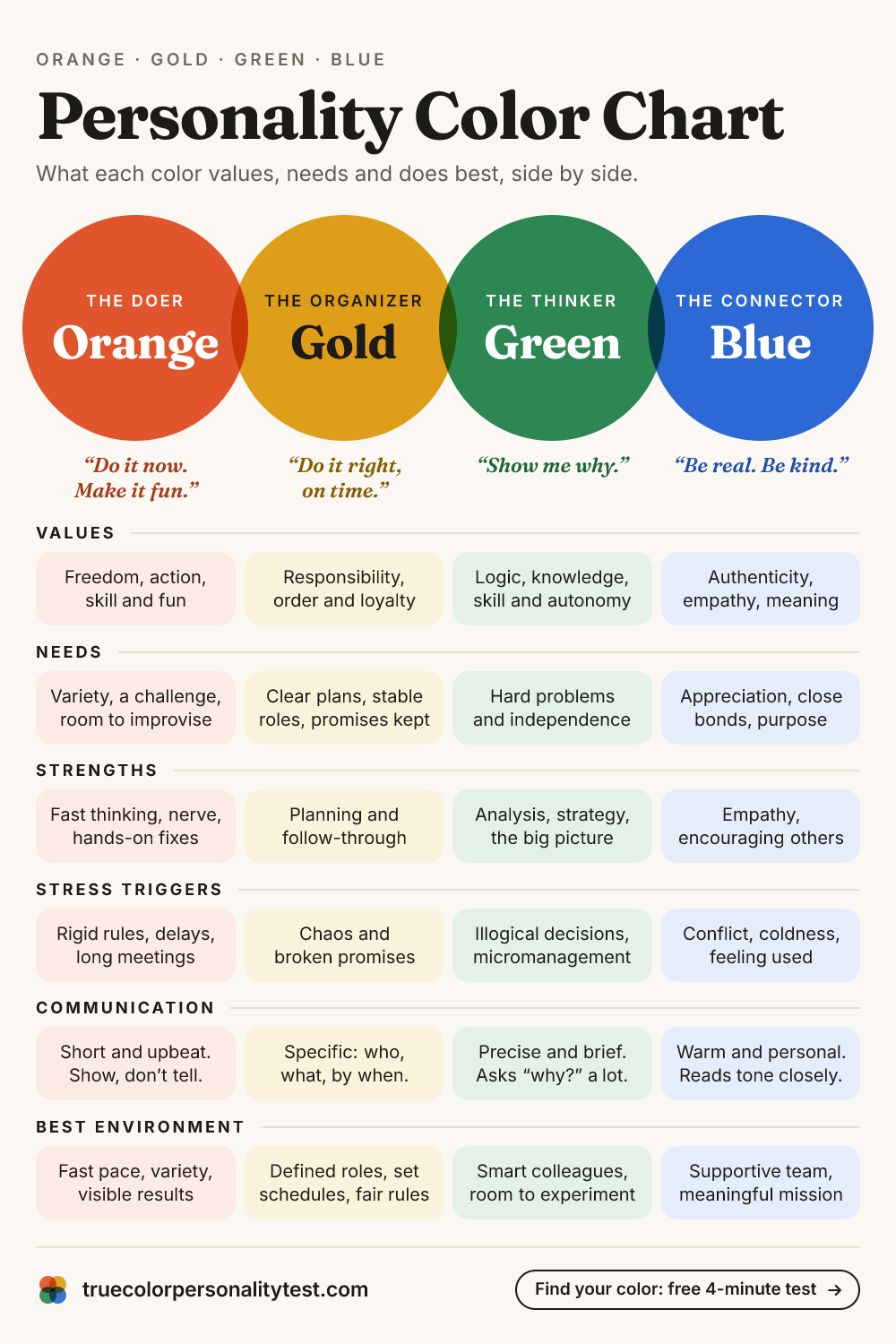
A personality color chart puts the four temperament colors side by side so you can compare them at a glance: Orange values freedom and action, Gold values responsibility and order, Green values logic and competence, and Blue values empathy and meaning. The charts below are free to download, pin, print and share, and each one covers a different question, from how to talk to each color to how the colors lead.
The personality color chart
Four columns, one per color, and six rows that answer the questions people ask most. Save it, print it or pin it.
PNG · 1000 × 1500 · free
Personality Color Chart
- Values: what each color cares about most
- Needs: what it takes to feel settled and do good work
- Strengths: what each color brings to a group
- Stress triggers: what wears each color down fastest
- Communication: how each color likes to talk and be talked to
- Best environment: the setting where each color does its best work
Want every color explained in full? Read our guide to what each personality color means, which also has this chart as a text table.
More free personality color charts
Each chart answers one question. Click any image to open the full-size PNG.
One-page cheat sheets
One color per page, sized 4:5 for Instagram and for 8×10 prints.
Orange Personality Cheat Sheet
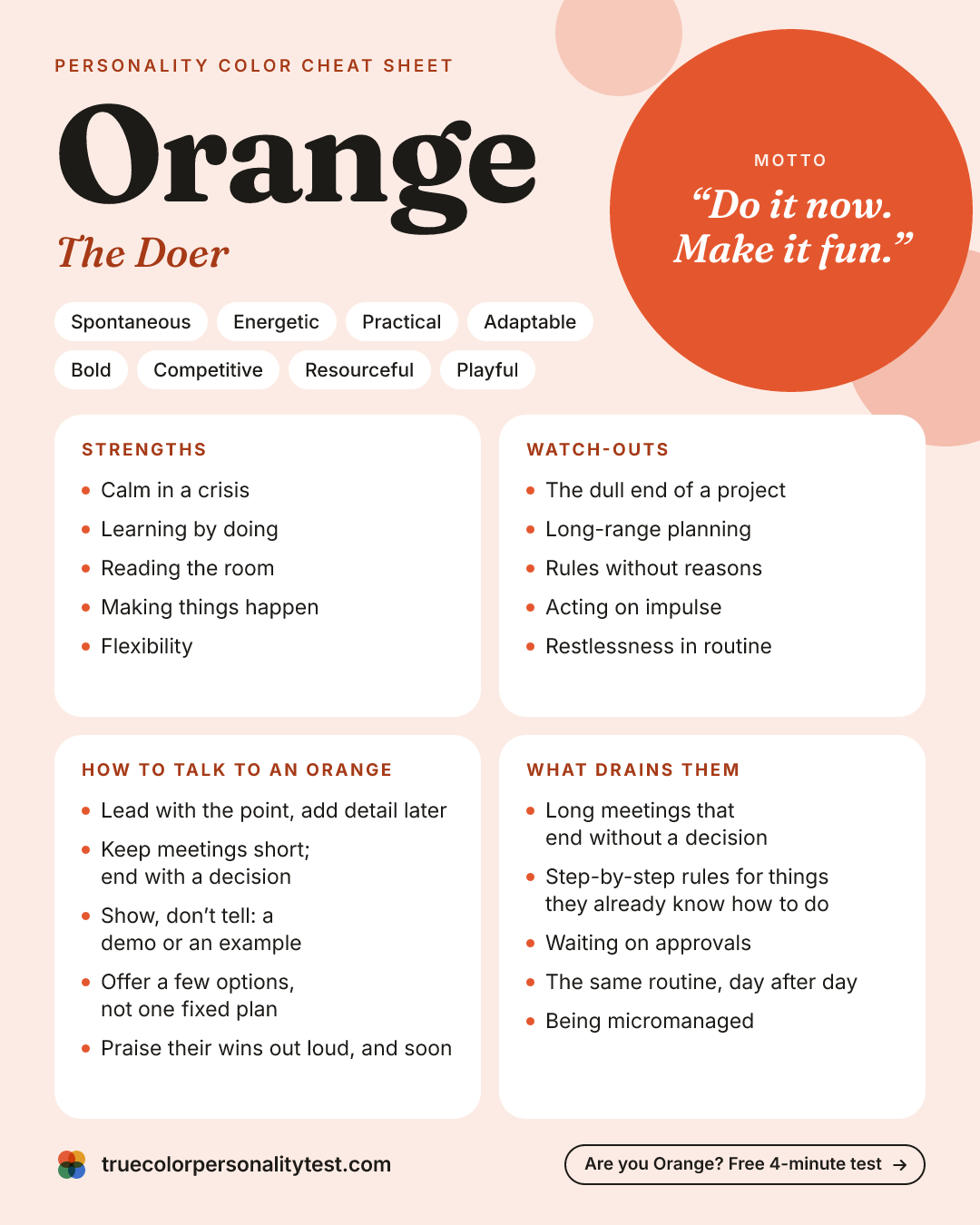
The Doer on one page: motto, top traits, strengths, watch-outs, how to talk to an Orange and what drains them.
Gold Personality Cheat Sheet
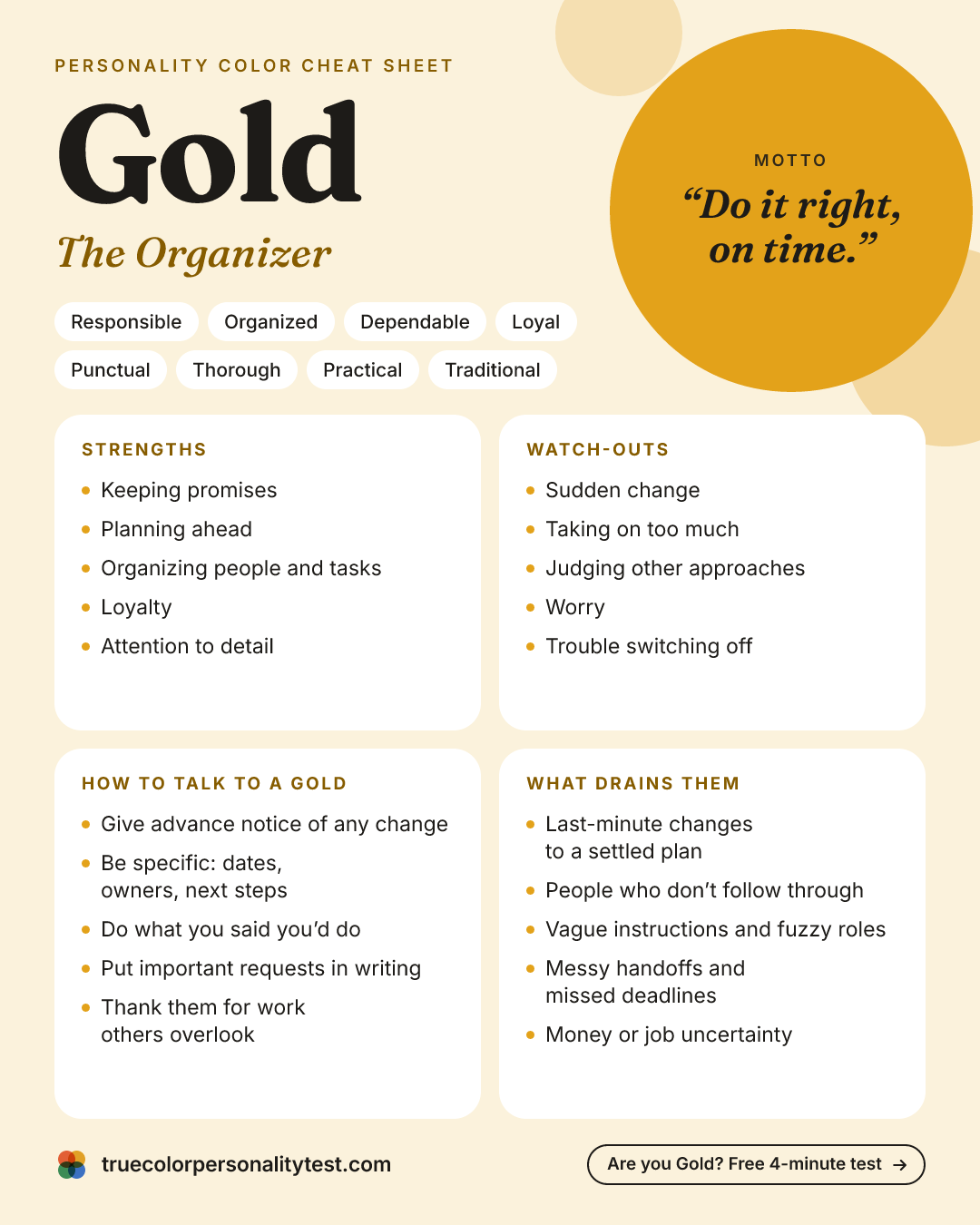
The Organizer on one page: motto, top traits, strengths, watch-outs, how to talk to a Gold and what drains them.
Green Personality Cheat Sheet
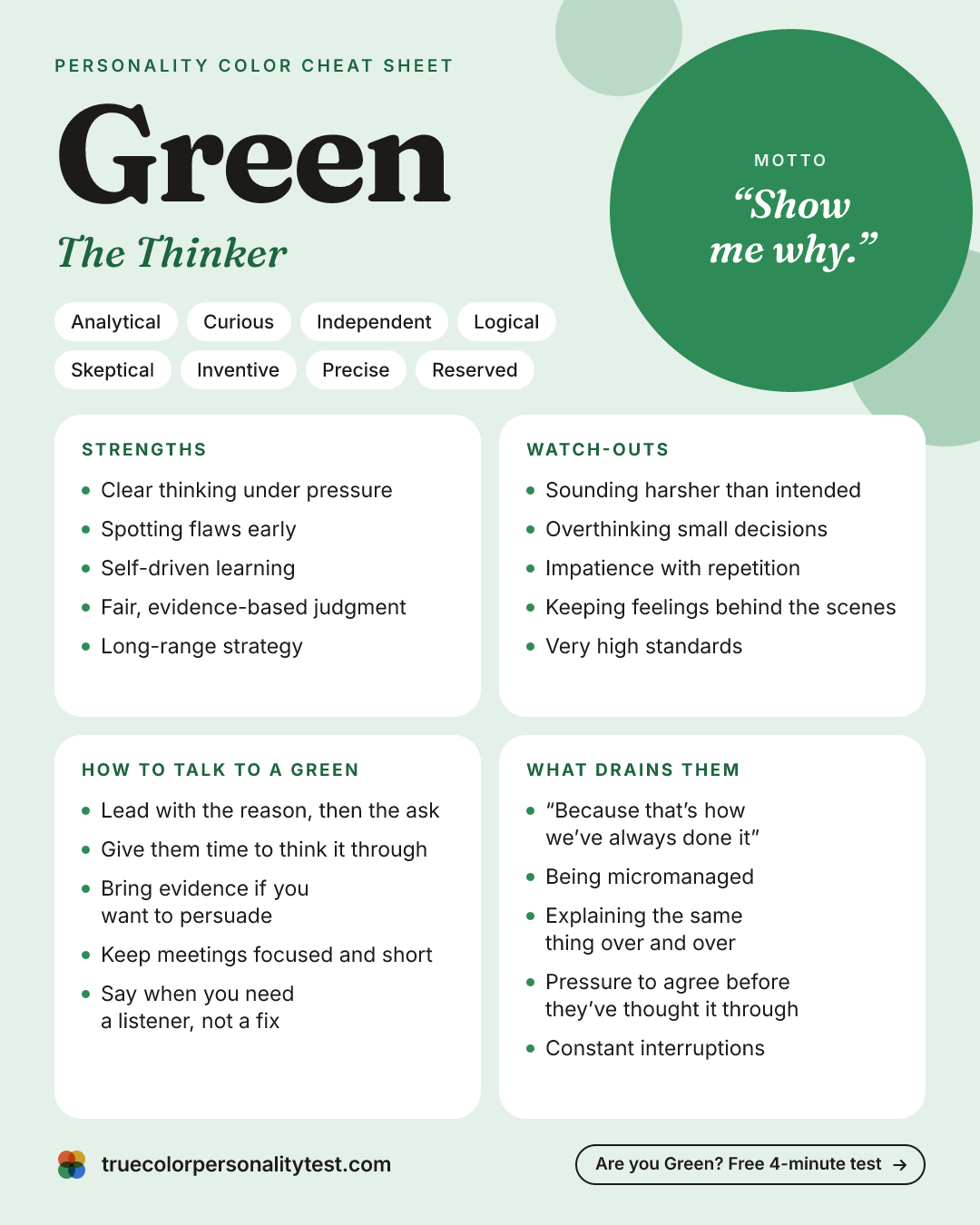
The Thinker on one page: motto, top traits, strengths, watch-outs, how to talk to a Green and what drains them.
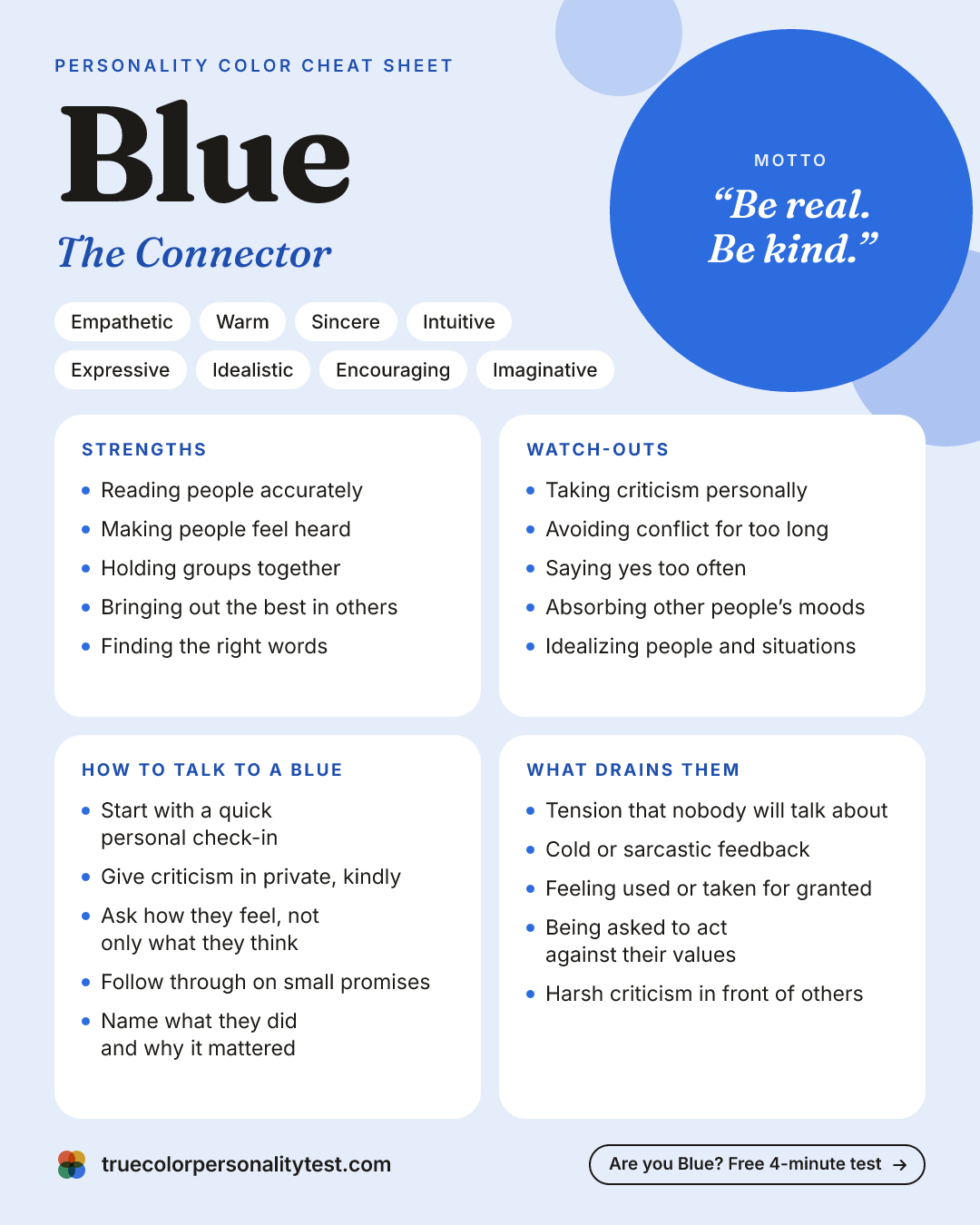
Blue Personality Cheat Sheet
The Connector on one page: motto, top traits, strengths, watch-outs, how to talk to a Blue and what drains them.
Side-by-side guides
All four colors on one tall page, sized 2:3 for Pinterest and for Letter or A4 handouts.
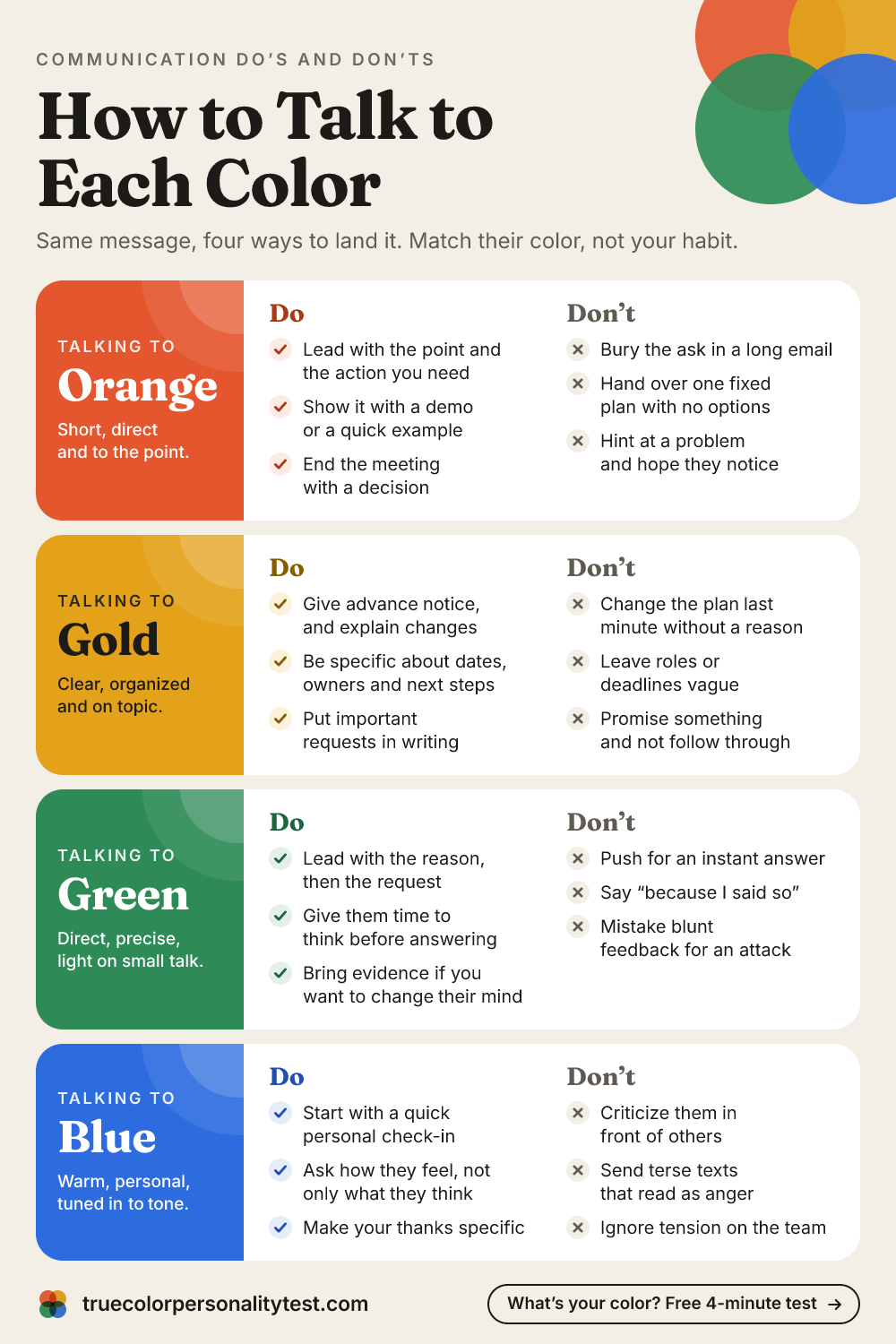
How to Talk to Each Color
Communication do’s and don’ts for Orange, Gold, Green and Blue, three of each.
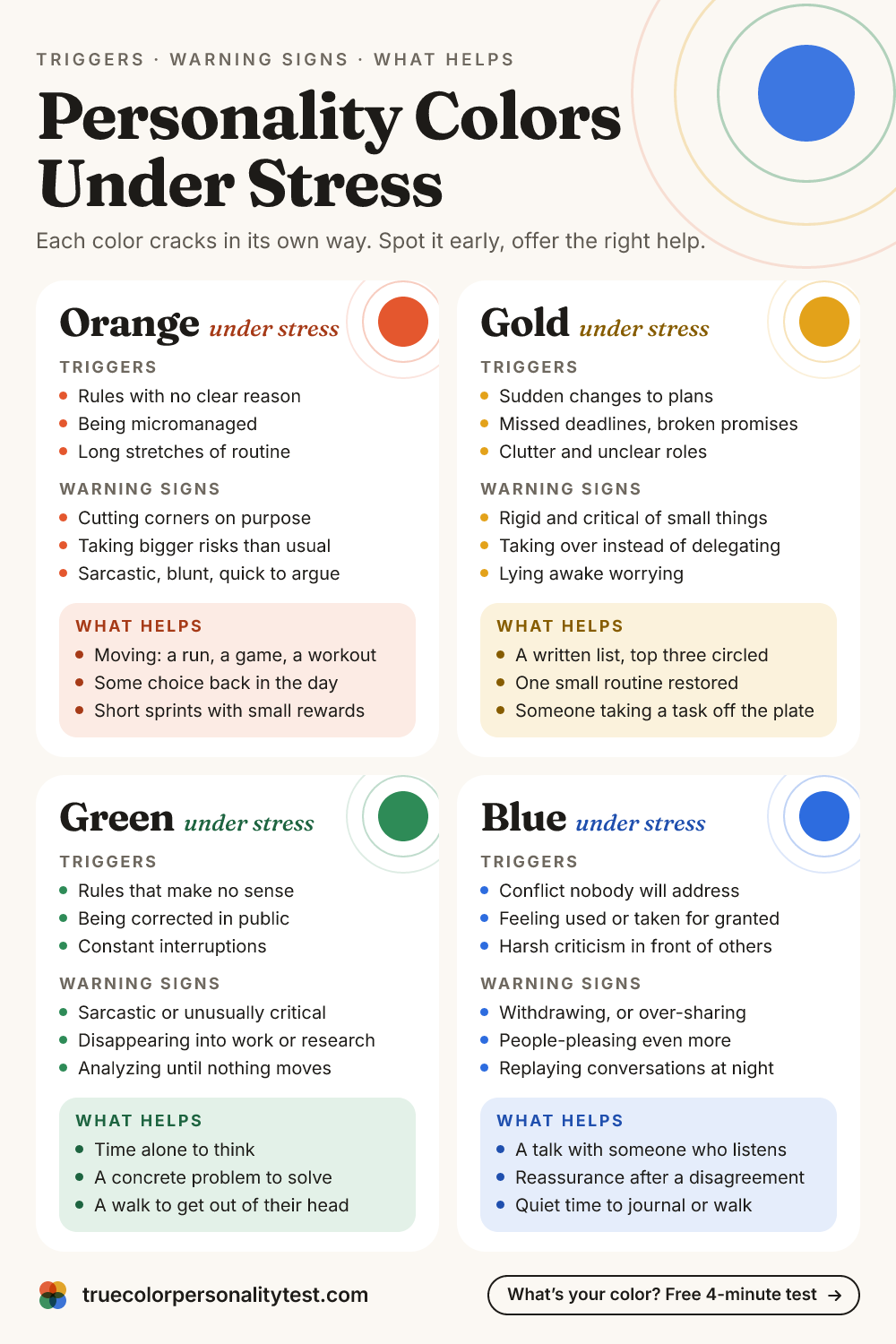
Personality Colors Under Stress
What sets off each color, the warning signs to watch for, and what actually helps.
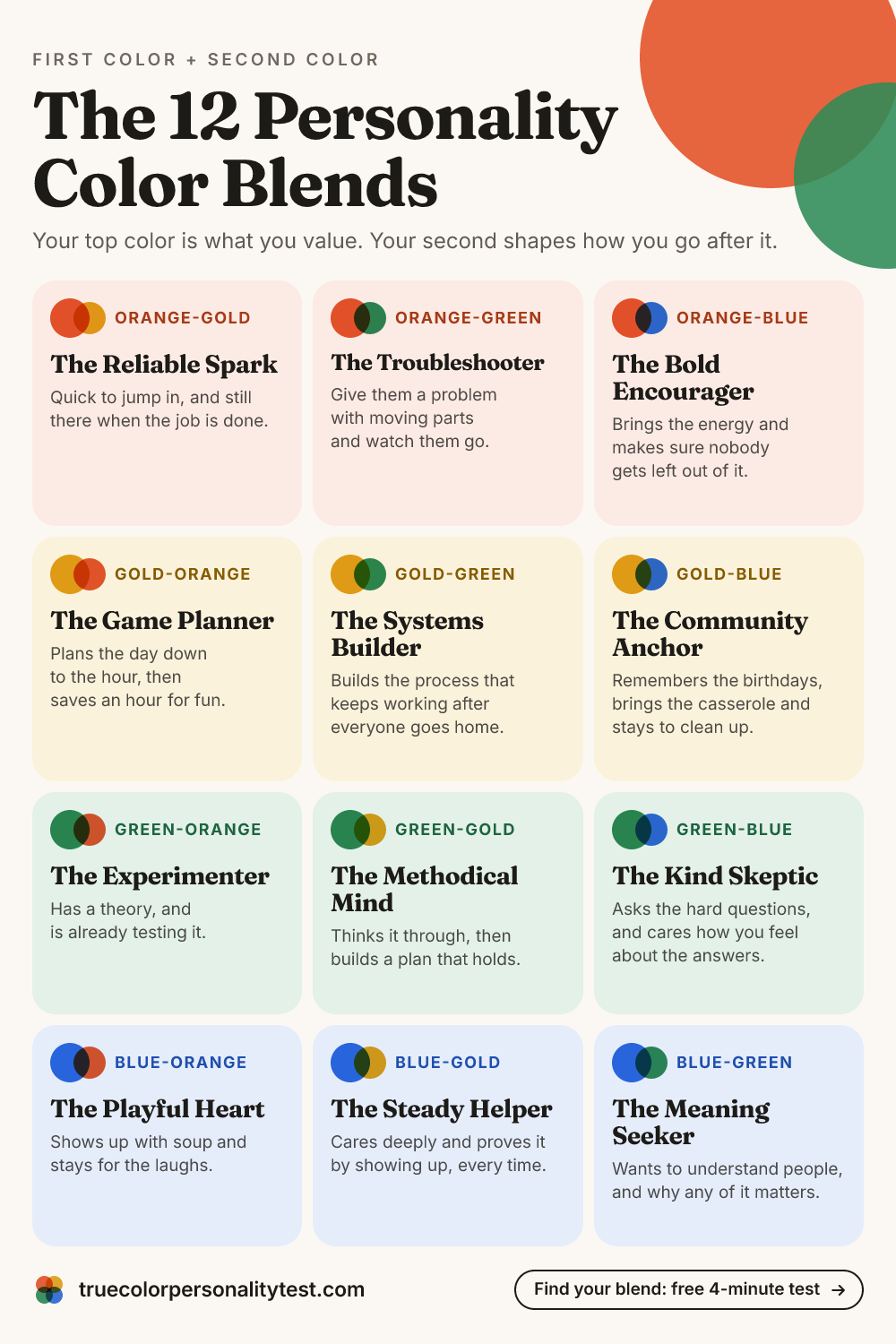
Personality Color Blends Chart
All 12 two-color blends, from Orange-Gold to Blue-Green, each with its nickname and a one-line summary.
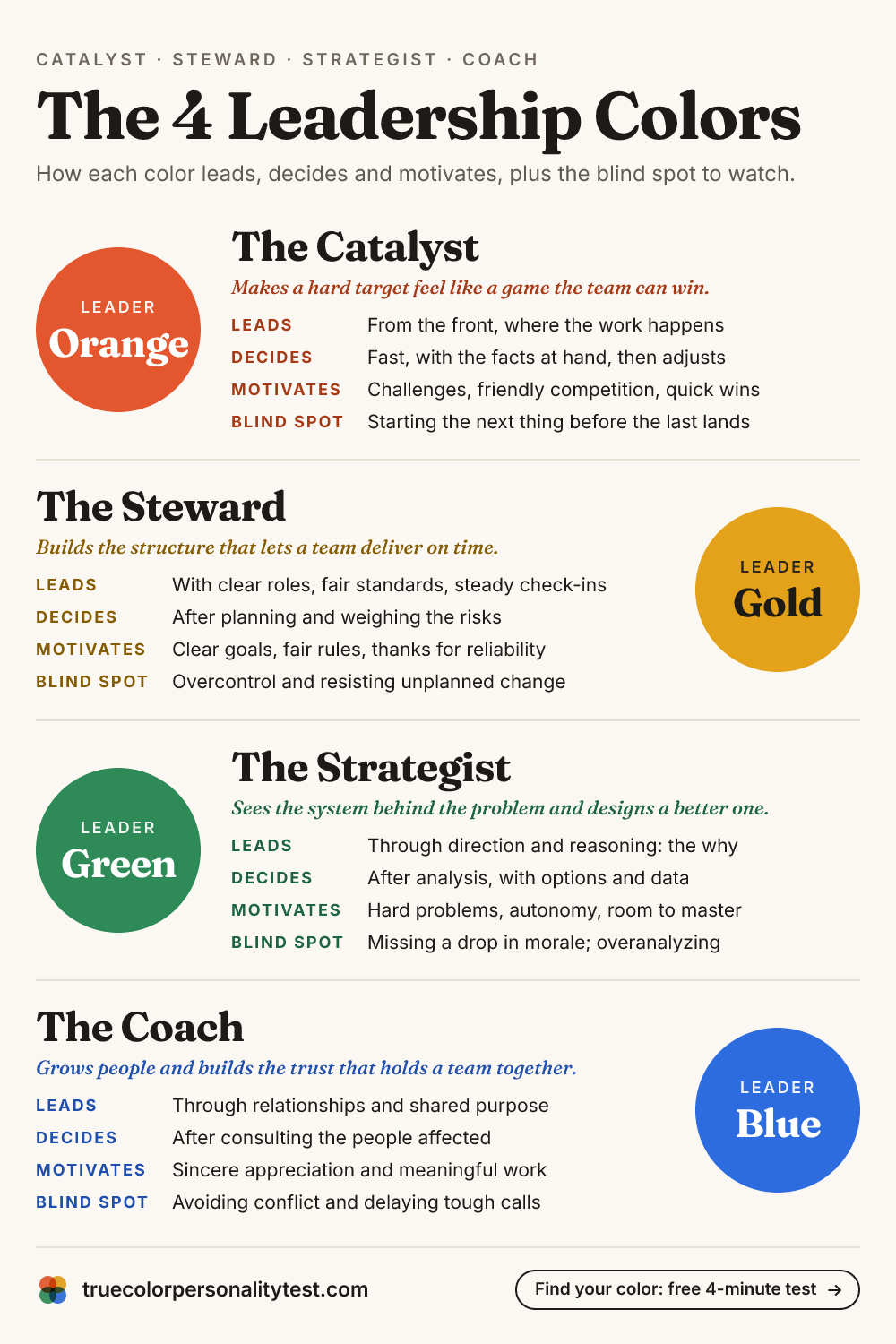
Leadership Colors Chart
Orange the Catalyst, Gold the Steward, Green the Strategist and Blue the Coach: how each leads, decides and motivates, and each one’s blind spot.
Lookup grids
Square charts for finding one answer fast: a pair of colors, or your four MBTI letters.
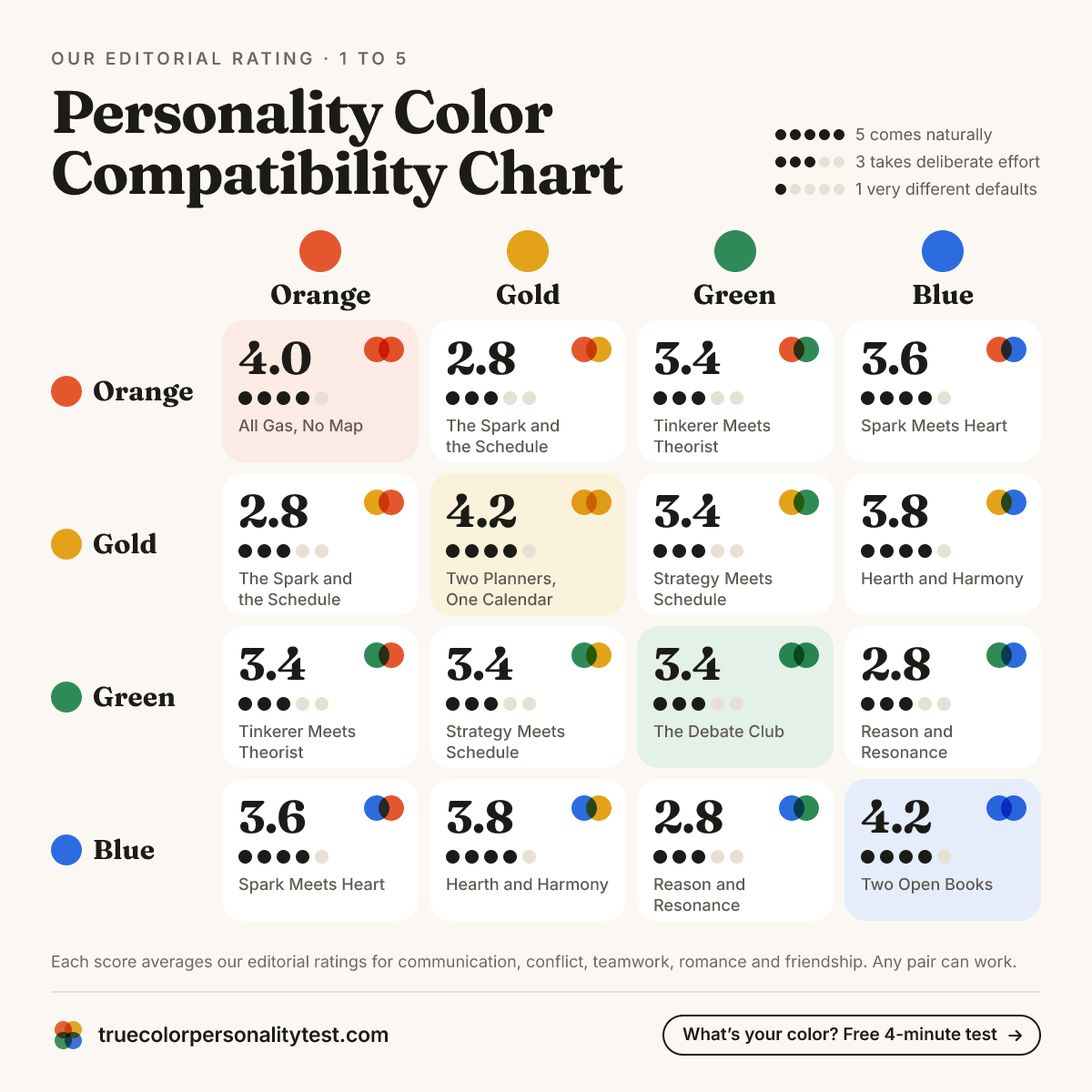
Personality Color Compatibility Chart
A 4×4 grid of our editorial ratings for every pairing of Orange, Gold, Green and Blue, averaged across communication, conflict, teamwork, romance and friendship.
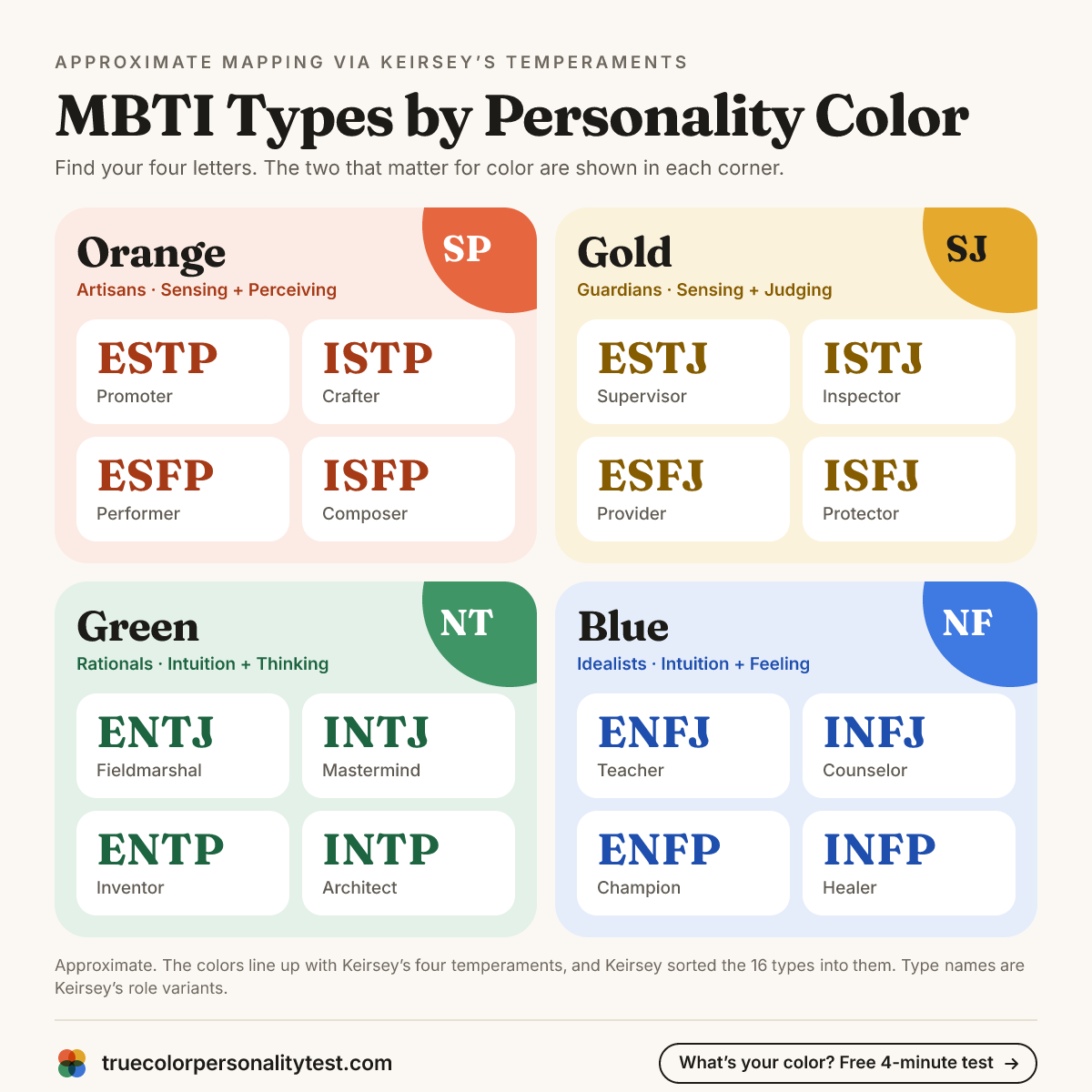
MBTI Types by Personality Color
All 16 Myers-Briggs types grouped by Keirsey temperament and matched to Orange, Gold, Green and Blue. An approximate mapping, labeled as one.
How to read a personality color chart
Each color stands for a temperament, a set of values and habits that tend to show up together. Read down a column to see one color’s whole profile, or across a row to compare how the four colors handle the same thing.
Start with the row that matches your question. If a coworker never answers your long emails, the communication row will tell you more than the values row. If a student goes quiet every time plans change, look at stress triggers.
Nobody is only one color, which is why the circles at the top overlap. Most people have a clear first color and a second one close behind, and the second color changes how the first one shows up. A Gold with a strong Green streak plans differently from a Gold with a strong Blue streak.
The blends chart names all twelve two-color combinations, and each one has its own profile on our color combinations page. For the meaning behind every row, see personality colors meaning.
About the labels
Two charts carry labels worth reading. The compatibility scores are our editorial ratings, averaged across five areas, not survey results. The MBTI chart is an approximate mapping through Keirsey’s temperaments: a useful bridge between two systems, not an exact translation for every person.
How teachers, trainers and managers use these charts
Teachers
Put the master chart on the wall before a group project. Students take the test, find their column, and form teams with at least three colors. The cheat sheets make good exit tickets: each student writes one thing they learned about a classmate’s color.
Classroom ideas and a lesson plan →Trainers and facilitators
Print a set of the four cheat sheets for each table. People sit with their color, then use the how-to-talk chart to plan how they would pitch the same idea to each of the other three groups. Comparing the four pitches is the debrief.
Printable test and 30-minute activity →Managers
Share the leadership and stress charts before an offsite or a reorganization. They give people neutral words for what they need, like “I need more notice” or “give me the reason first,” without it sounding like a complaint.
The four colors at work →Printing tips
- 1Print in color. The pale tints carry the color coding. Grayscale printers wash them out, and the chart turns into a plain table.
- 2Pick “Fit to page.” The tall 2:3 charts fill a portrait Letter or A4 sheet with a small margin. The square grids fit landscape or portrait.
- 3Match the paper to the chart. The 4:5 cheat sheets are exactly the shape of an 8×10 photo print, and they make sturdy table cards on cardstock.
- 4Keep it handout-sized. The files are 1,000 to 1,200 pixels wide, sharp at Letter or A4 and below. Blown up to poster size, they’ll look soft.
- 5Laminate the wall copy. A laminated master chart survives a school year of pointing, and you can circle colors on it with a dry-erase marker.
License and credit
Free to share and print with a link back to this page.
You’re welcome to print these charts for classrooms, workshops, team meetings and home, and to pin, post or embed them on a blog, a school site or an intranet. When you share one online, keep the site name on the image and link back to this page. The embed code under each chart does both for you.
Please don’t sell the charts, put them behind a paywall, or crop out the credit.
Need something the license doesn’t cover? Get in touch.
Independent site. Not affiliated with or endorsed by True Colors International. True Colors is a trademark of its owner.
Personality color chart FAQ
What is a personality color chart?
A personality color chart compares the four temperament colors, Orange, Gold, Green and Blue, in a single table. Each column covers one color and each row covers one question, such as what that color values, what stresses it or how it likes to communicate. It’s a quick reference for seeing why people approach the same situation in such different ways.
What do Orange, Gold, Green and Blue mean?
Orange stands for action and freedom, Gold for responsibility and order, Green for logic and competence, and Blue for empathy and meaning. The system goes back to 1978, when Don Lowry turned David Keirsey’s temperament theory into four colors. Everyone has all four in some mix, so your top two colors describe you better than one color alone.
Can I print these charts for my classroom or team?
Yes. Every chart is free to print for classrooms, workshops, team meetings and personal use. Print in color on Letter or A4 paper with “Fit to page” selected. If you share a chart online, keep the site name on the image and link back to this page. The embed code under each chart includes that link for you.
How do I find out which color I am?
Take the free four-minute test on our homepage. It asks 24 quick questions and shows your blend of all four colors, with a primary and a secondary color. Then find your column on the master chart, look up your two-color combination on the blends chart, and open the cheat sheet for your top color.
Is this the official True Colors chart?
No. These charts are original work from an independent site that isn’t affiliated with True Colors International, which owns the True Colors trademark. They follow the same four-color temperament tradition, so the colors carry similar meanings, but the wording, the ratings and the designs are our own.
Why are some charts labeled “editorial” or “approximate”?
Because they are judgment calls, not measurements. The compatibility scores are our editorial ratings, averaged across communication, conflict, teamwork, romance and friendship. The MBTI chart matches the 16 types to colors through Keirsey’s four temperaments, a common bridge between the two systems that won’t fit every person exactly.
Which column is yours?
Take the free 4-minute test, then find your color on the chart.
Take the free test